Elder care
Blood pressure and heart rate from a watch: reading them sensibly
A blood pressure watch for elderly parents gives the family a record, not a diagnosis. Which readings a watch may report, adding home monitor readings, curves over time, who in the family sees them, and why to ask the doctor.
Ashish Srivastava5 min read
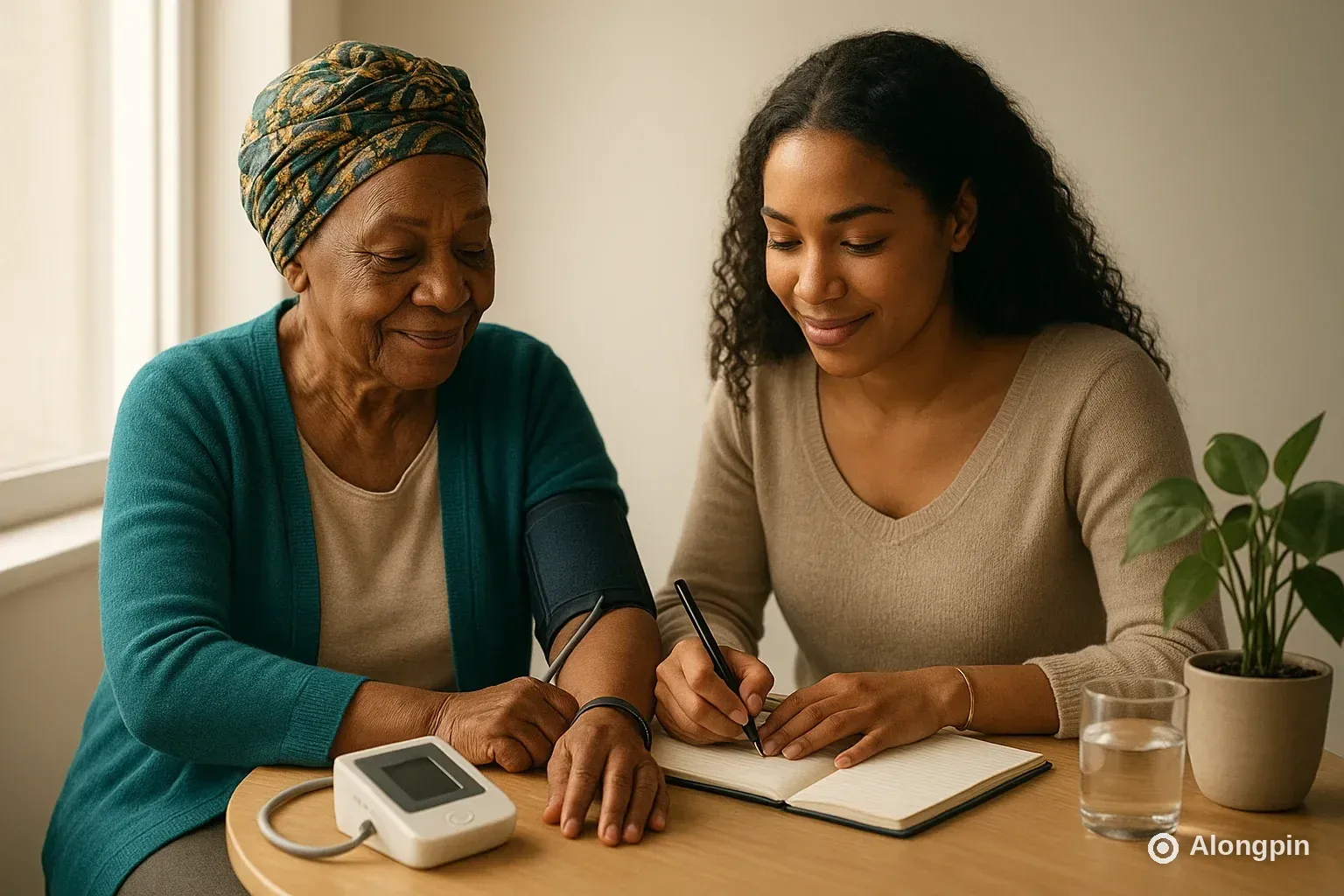
A blood pressure watch for elderly parents can give the family a useful record, as long as everyone reads it sensibly. Some health watches report heart rate, blood pressure or blood oxygen; many report none of them. In an Alongpin care profile, the latest values the watch sent appear on the profile, each day's heart rate appears in the wellness view, and readings taken with a home blood pressure monitor can be added by hand and seen as a curve over weeks and months. The result is something to show the doctor. It is not a diagnosis, and no single figure should be read as one.
Key takeaways
- Only some watches report heart rate, blood pressure or oxygen. Check the model before you buy.
- The watch's latest readings show on the profile; each day's heart rate (low, average, high) shows in wellness.
- Readings from a home monitor are added as measurements and drawn as a curve over time.
- Health readings are visible only to the owner and people with a health share, and every read is logged.
- Consumer readings are not a diagnosis. Bring the curve to the doctor and ask.
Which readings can a watch report?
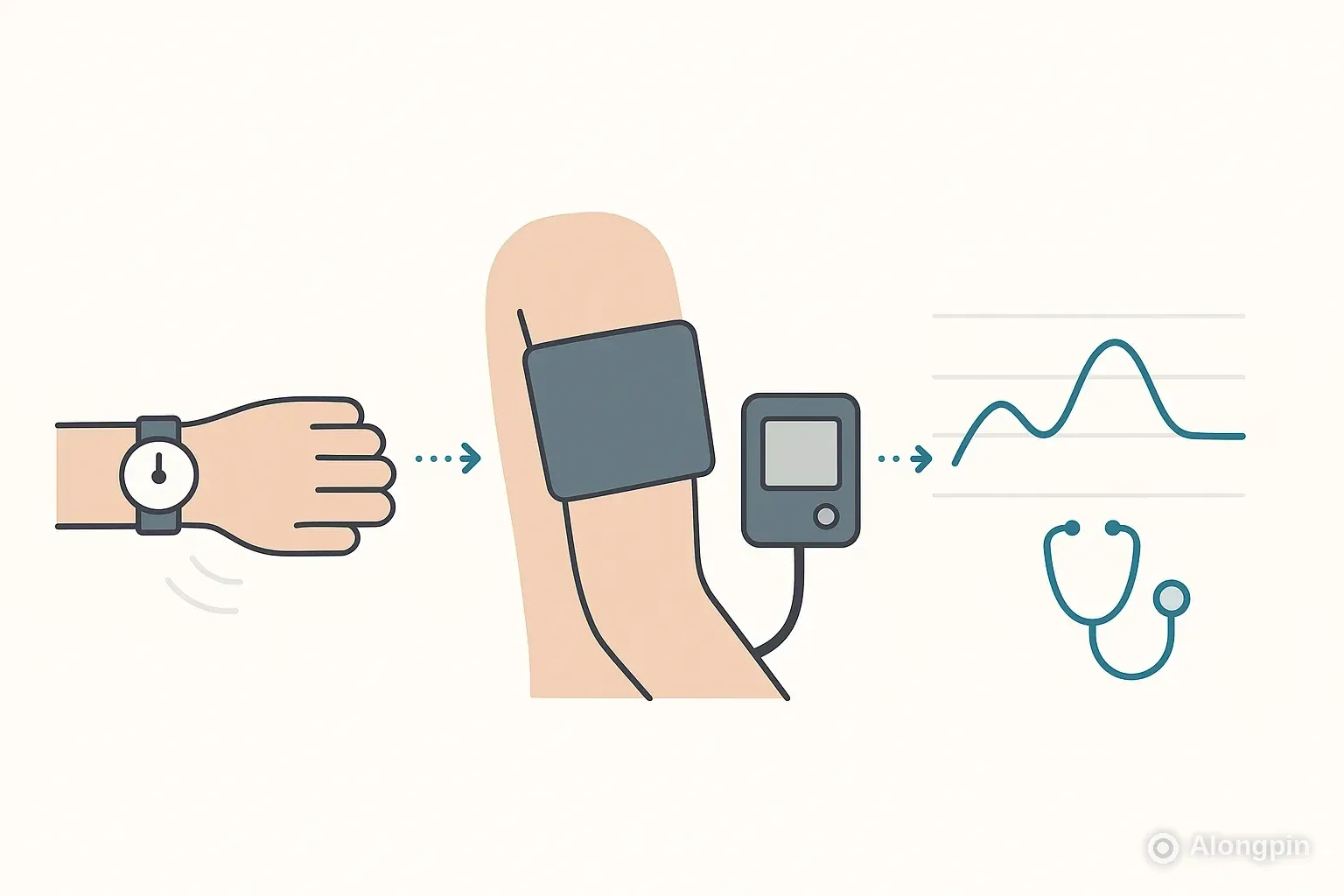
A GPS watch for an older person is first a locator with an SOS button. Some models, often sold as health watches or health bands, add sensors and report:
- heart rate, the most common;
- blood pressure, on some models, estimated by the watch rather than measured with a cuff;
- blood oxygen;
- body temperature, on a few.
Many watches report none of these, and simple personal alarms report position, battery and an SOS. The platform shows a reading only when the watch sends it; it cannot measure anything itself. Before you buy for this reason, look up the model on the watches page or ask the seller exactly which values it reports.
What will the watch not tell you?
Even a health watch does not measure what a doctor measures. Wrist readings are affected by how the watch sits, movement, cold hands and the sensor itself. A watch's blood pressure is not a cuff measurement. And the platform does not check any reading against medical limits: there is no alert for a high or low value. The care alerts are SOS, fall, leaving home, low battery and no movement.
Where do the watch's readings appear?
Open Pets and elders and your parent's profile:
- On the Overview, the card From the watch shows the latest values the watch sent, such as heart rate, Oxygen, Blood pressure and Body temp., with the battery and the time of the latest position. These are the latest values only.
- The Wellness tab shows, for each day, the lowest, average and highest heart rate, next to steps, active time and time at home.
If a reading never appears, the watch probably does not send it, or it is not linked to the profile. Health readings not showing walks through the checks.
How do I add readings from a home monitor?
A home blood pressure monitor with an arm cuff is usually the better source for blood pressure. Record what it shows as a measurement: open the profile, Records and documents, then Measurements, and choose Add measurement. Pick the type (Blood pressure, Heart rate, Weight, Temperature, Blood glucose, Oxygen saturation, Height or Other), enter the value, and for blood pressure the systolic as the value and the diastolic as Value 2. The unit is filled in from the type (mmHg for blood pressure). The time defaults to now; change it if you are typing in yesterday's readings. Add a note when it helps: "after the walk", "before the morning tablets".
To keep a reading the watch sent in the long-term history, add it the same way. Recording a measurement by hand has the form field by field.
How do I see a curve over time?
The Measurements page draws each type over the period you choose (30 days, 90 days, A year or a custom range) and lists every reading below. For blood pressure you see the systolic and diastolic values together.
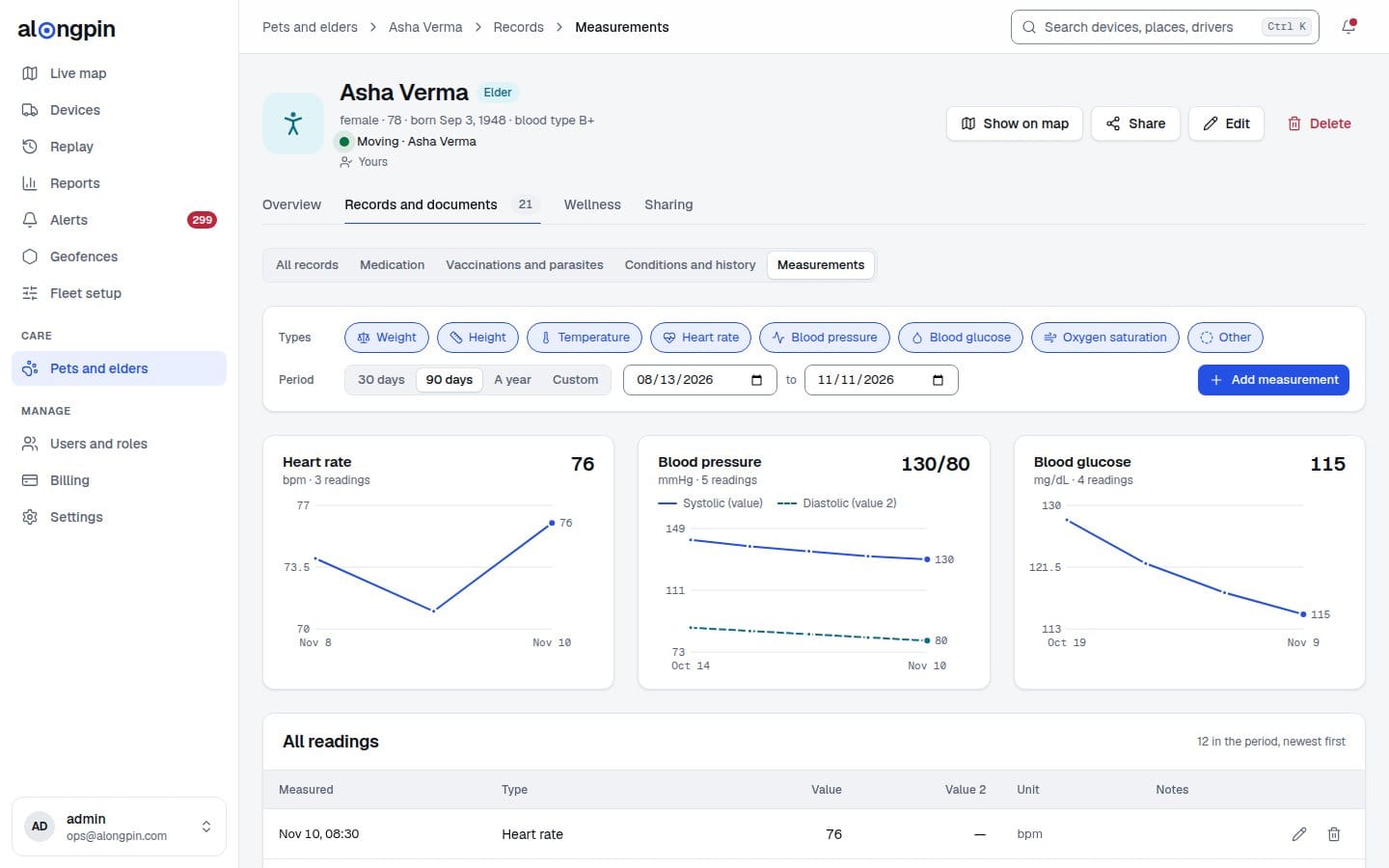
Curves are where readings start to make sense:
- Take readings the same way each time: same arm, same time of day, seated and rested. A curve of readings taken any old way shows mostly the way they were taken.
- Look at weeks, not single values. One high reading after climbing the stairs means little. A level that has drifted over a month is worth a question.
- Note what changed: a new medicine, a stay in hospital, a hot spell. The notes field is there for it.
Who in the family can see health readings?
Health readings are health data, and the care profile treats them that way:
- The owner and people the profile is shared with for Everything see them.
- A doctor given Health data only sees the measurements, with no map or alerts.
- Location only shares see neither the readings nor the heart rate in wellness; the watch's vital signs are left out of what they receive.
- Every read is logged on the profile's Who viewed page, which the owner and administrators see.
- Where consents are required, health data stays locked, for the owner too, until a health consent of your parent or her legal representative is recorded.
So a cousin who helps with the shopping can see where she is without seeing her blood pressure. The health readings page describes these rules in full.
How should the family use the readings?
Consumer readings are not a diagnosis. Use them for three things:
- A record to show the doctor. At the next appointment, a month of home measurements tells the doctor more than one reading taken in a waiting room. Share the profile with the doctor for Health data only, with an end date, or bring the list.
- A prompt for a conversation. "Your readings have been higher this month; shall we mention it to the doctor?" is a question, not a verdict.
- Continuity between carers. When a sister takes over for a week, the history is there.
Do not change a medicine, a dose or a routine because of a watch reading. If a reading worries you, or your parent feels unwell, call the doctor, or the emergency number if it is urgent.
What about privacy for her?
Readings about the body are among the most personal data there is. Ask your parent before you switch on a health watch or start recording measurements, explain who will see them, and let her decide which readings she is comfortable sharing. The elder care solution shows how families set up profiles, consents and shares around an older parent.
How Alongpin helps
Alongpin (alongpin.com) is a GPS tracking platform you open in a browser or on your phone. A parent's GPS watch or alarm becomes a care profile: SOS, fall, leaving-home and inactivity alerts reach the family and emergency contacts, and health readings, medication refills and appointments sit in one place you can share. See how it works for elder care, and check a watch in the device check.
Frequently asked questions
Can a watch replace a blood pressure monitor?
No. A watch's estimate is not a cuff measurement. Use a home monitor for blood pressure and add its readings as measurements.
Will I get an alert if her blood pressure is high?
No. The platform does not check readings against limits and raises no alert for them.
Why does heart rate show in wellness but not on the map for my brother?
His share is probably Location only, which leaves heart rate and other readings out.