Watches and trackers
What a GPS watch can report: location, steps, heart rate and more
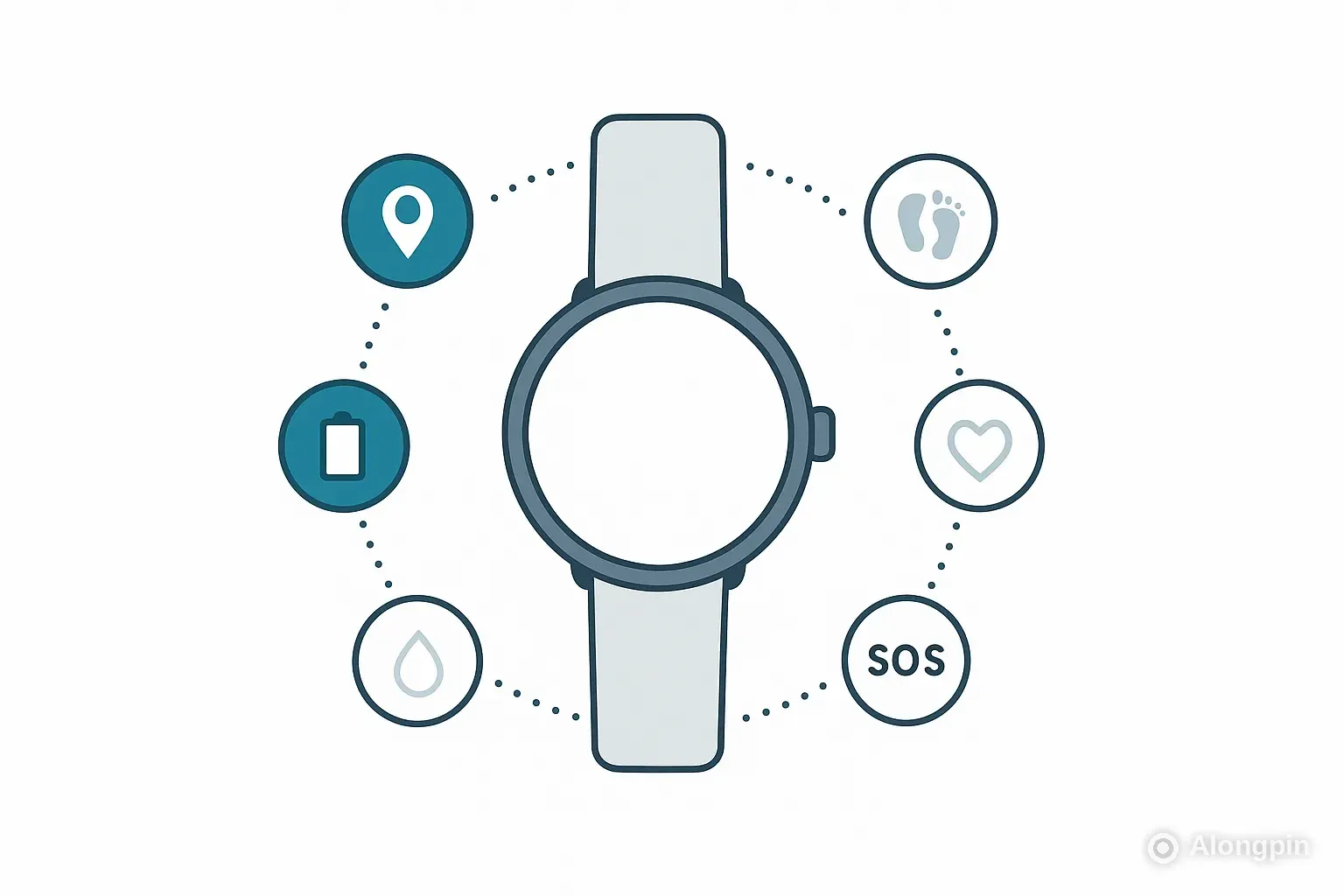
Every GPS watch reports position, time and battery. Most add SOS and steps; some report heart rate, blood pressure, oxygen or falls. What each reading is, where it appears on Alongpin, and why the model decides what you see.
Ashish Srivastava6 min read
What a GPS watch can measure depends on the model, but every watch reports its position, the time of that position and its battery level. Most add an SOS button and a step count. Some, sold as health watches or bands, add heart rate, blood pressure, blood oxygen or body temperature, and a few detect falls. Alongpin shows each reading the watch sends: the latest values on the person's care profile, daily figures in the wellness view, and alarms as alerts. A reading the watch does not send cannot appear, so the list on the box matters more than any feature of the platform.
Key takeaways
- Always: position, the time it was taken, and the battery level.
- Often: an SOS button and steps.
- On some models: heart rate, blood pressure, oxygen, temperature, fall alerts and a "taken off" alarm.
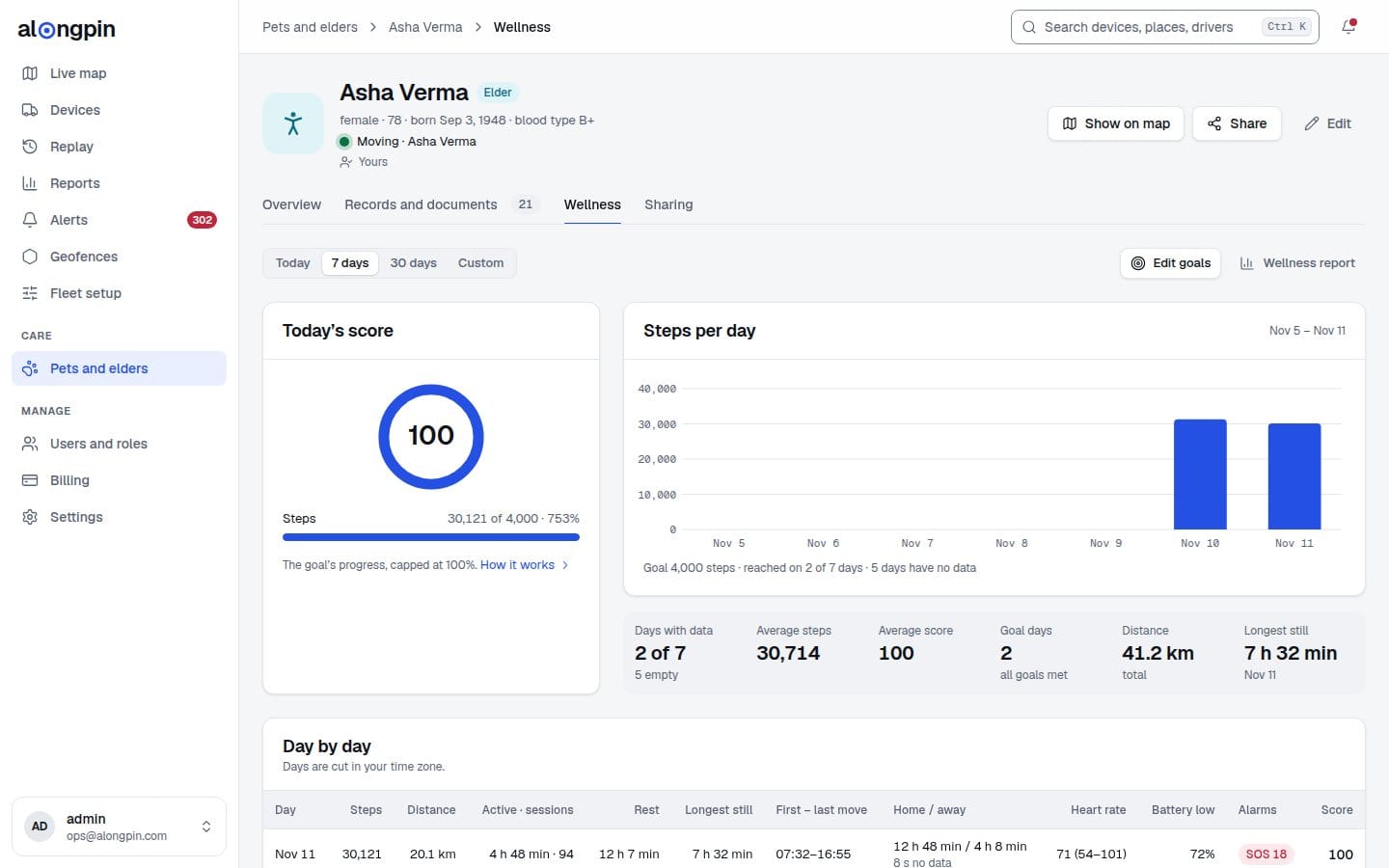
- Latest readings appear on the care profile; daily steps, activity and heart rate in the wellness view.
- The platform does not judge readings or raise an alert for a high or low value.
- If the watch does not send it, the platform cannot show it. Check the model first.
Always: position, time and battery
Every GPS watch reports where it is and when. Outdoors, the position usually comes from GPS; indoors, many watches fall back to an estimate from mobile cells or Wi-Fi, which is less exact. The time matters as much as the place: a position from twenty minutes ago is not where the wearer is now. How accurate is a GPS watch explains both.
The battery level comes with the reports, and the platform can alert you when it runs low, which for a watch that needs charging every day or two is often the most useful alert of all.
Often: an SOS button and steps
Most watches for children and older adults have an SOS button. Pressing it sends an alarm with the position, which the platform turns into an alert to the people you chose. Many also make a call to a set number, which is a feature of the watch, not of the platform.
Steps are the activity reading most watches offer. Simple children's watches often report steps and nothing else beyond position and battery. Steps are counted by the watch, so two models can disagree on the same walk.
On some models: heart rate, blood pressure, oxygen and falls
Health watches and bands carry extra sensors. Depending on the model, they report:
- heart rate, the most common health reading;
- blood pressure, estimated by the watch at the wrist, which is not the same as a cuff measurement;
- blood oxygen;
- body temperature, on a few;
- a fall alert, on some watches and personal alarms made for older adults. The fall is detected by the device; the platform does not work out falls from movement itself;
- a "taken off" alarm, when the watch is removed from the wrist.
On Alongpin, the watch families differ: Wonlex- and SeTracker-type watches report heart rate, blood pressure, oxygen and temperature only on health models; Topin-type children's watches and B2316-type bands report heart rate; MiniFinder-type alarms report falls. The watches page lists what each family sends.
How readings appear over time
For an older relative or a child with a care profile, the readings come together in one place under Pets and elders:
- The profile's overview shows the latest values the watch sent, such as heart rate, oxygen, blood pressure and temperature, next to the battery and the time of the latest position. These are the latest values only.
- The Wellness tab shows each day: steps, active time, distance and time at home against goals you set, and the lowest, average and highest heart rate of the day where the watch reports it.
- Measurements keeps readings you enter by hand, for example from a home blood pressure monitor, and draws them as a curve over weeks and months.
Alarms go a different way: an SOS, a fall or a low battery becomes an alert to the people and contacts you chose, by app, email or text message, depending on what is set up for your account. The health readings page explains the wellness view, measurements and reminders.
Health readings are treated as health data. Only the profile's owner and people it is shared with for health data see them; a location-only share leaves them out, and every read of health data is written to an access log.
What the readings are not
A wrist reading is affected by how the watch sits, movement, cold hands and the sensor itself. The platform shows what the watch sends and does not check it against medical limits, so there is no alert for a high or low heart rate. Use the curves to notice a change over weeks and to bring something concrete to the doctor, not to make a diagnosis. Blood pressure and heart rate from a watch goes into reading them sensibly.
If the watch does not send it, the platform cannot show it
A common disappointment with a GPS watch is a feature on the box that never appears on the screen. Usually one of three things is going on:
- The model has no such sensor, or the seller's description covered a different version.
- The watch measures it but does not send it over its protocol, keeping it for its own app.
- The watch is not linked to the person's care profile, so readings arrive on the device but not on the profile.
Before you buy for a particular reading, ask the seller exactly which values the watch sends to a server, and type the model into the device check. After buying, health readings not showing walks through the checks.
Questions to ask before you buy
A seller's page lists what the watch can do on its own, with its own app. What matters for a tracking service is what the watch sends to a server. Ask, and keep the answers:
- Which protocol does it use? The protocol name, such as the plain word "watch" for Wonlex- and SeTracker-type models, is what the device check looks for.
- Which readings does it send to the server, and how often? Heart rate measured once a day is a different thing from heart rate every few minutes.
- Does it detect falls, and does it send the fall as an alarm? A fall shown only on the watch's own screen does not reach the family.
- How is the server address set? By text message, by a configuration tool, or not at all, because the watch is locked to its maker's app.
- Which mobile networks does it support? A watch made for a network your operator no longer runs will not connect, whatever it measures.
A seller who cannot answer these is a reason to choose another model. The answers also help later, when you set up alerts and explain to the wearer what the watch reports about them.
How Alongpin helps
Alongpin (alongpin.com) is a GPS tracking platform you open in a browser or on your phone. It works with many GPS watches and personal trackers: position, SOS, battery and, where the watch measures them, health readings, all in one app for the family. See the watches it works with, check a model in the device check, and sign up.
Frequently asked questions
Can the watch tell me my parent's blood pressure is too high?
The platform shows the readings but raises no alert on a value. Talk to the doctor about what to watch for, and use the curves to show them.
Do children's watches report heart rate?
Most do not. Simple children's watches report position, battery, SOS and often steps. Topin-type children's watches report heart rate.
Can I add readings the watch does not take?
Yes. On a care profile you can record measurements by hand, such as weight, glucose or a cuff blood pressure, and see them over time.