Fleet management
Fleet tracking pricing explained: per device or per account
Fleet tracking is priced per device or as one price for the account up to a device limit. When each fits, what hardware and SIMs add, how trials, upgrades, pausing and cancelling work, and a worksheet for comparing offers.
Ashish Srivastava6 min read

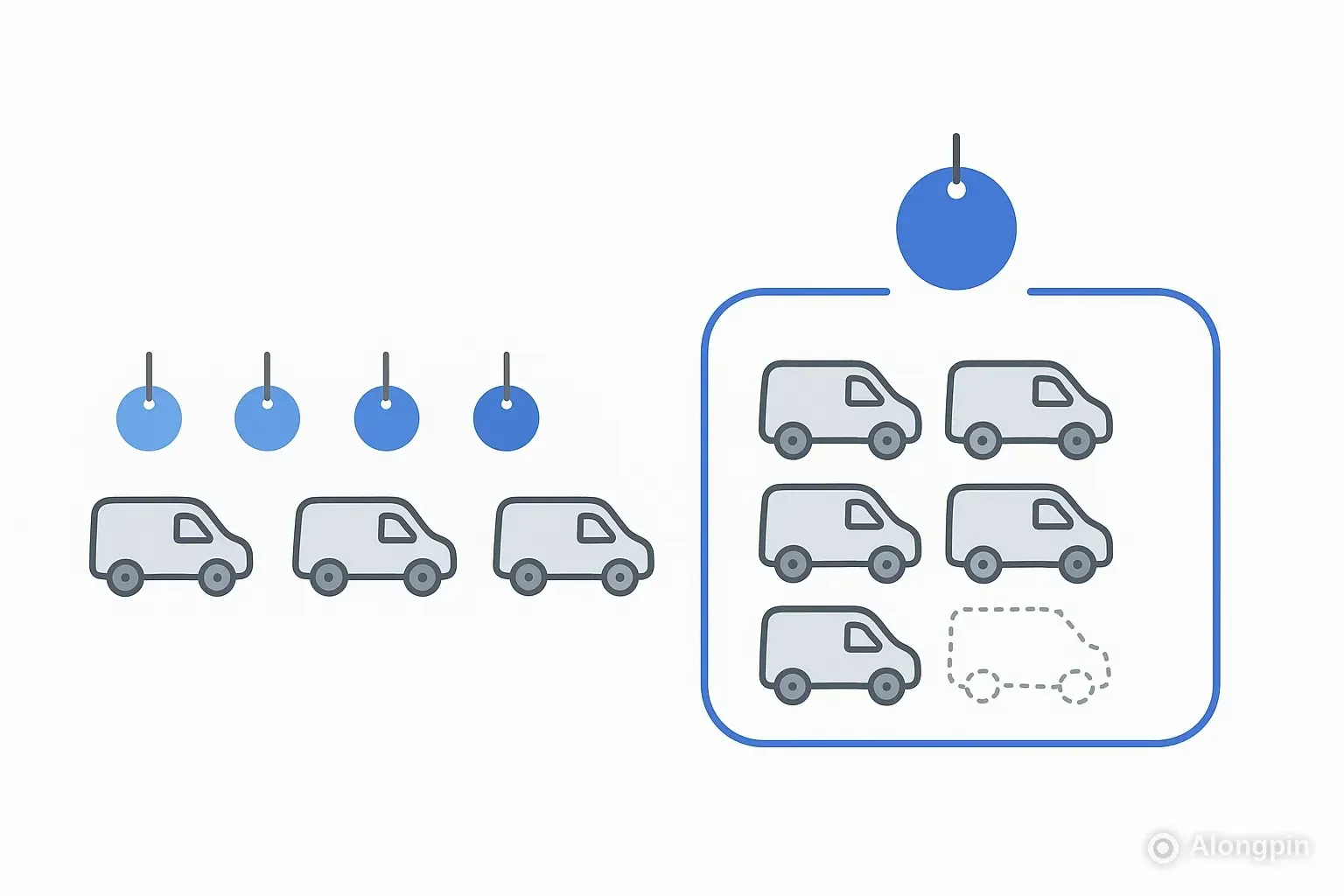
Fleet tracking pricing comes in two shapes: a price per device, or one price for the whole account up to a device limit. Per device suits small or changing fleets, because you pay for exactly the vehicles you track. A whole-account package suits larger, steadier fleets, because one subscription covers every device up to the limit, including vehicles you add later. In both cases the tracker hardware and its SIM are separate costs. This article explains each model, what a trial and a change of plan look like, and gives you a worksheet for comparing offers.
Key takeaways
- Per device: each tracker has its own plan. Good for a few vehicles, or a fleet whose size changes from month to month.
- Whole account: one subscription covers the account and every device you own, up to the package's device limit.
- Trackers and SIM data plans are bought separately, whichever model you choose.
- Look at what each package includes (features, how many days of history) as well as the price.
- Trials, upgrades, downgrades, pausing and cancelling all have rules worth reading before you sign.
Per-device packages and when they fit
With a per-device package, every tracker you subscribe has its own plan, its own period and its own renewal. Adding a vehicle means subscribing one more device; selling a vehicle means cancelling that one plan.
This fits when:
- you track a handful of vehicles, or a mix of vehicles and other assets;
- the number of vehicles changes with seasons or contracts;
- different vehicles need different features, for example video on a few trucks and basic tracking on the vans.
The gps tracking cost per vehicle is easy to see and easy to pass on to a customer or a cost centre. The drawback is administration: fifty vehicles means fifty plans, each with its own date.
Whole-account packages and device limits
A whole-account package covers your account and every device you own, including devices added later, up to the package's device limit. Above the limit, new devices are refused until you change package. One subscription, one renewal date, one invoice.
This fits when:
- the fleet is larger and fairly stable;
- you want one invoice and one date to watch;
- most vehicles need the same features.
You can use both: a device with its own plan works as long as either plan covers it. That lets you put the core fleet on an account package and add a short-term rental van on a per-device plan.
What a package includes
Price is only half of a package. Each one lists its features, and many set how many days of history you can look back on. A cheap package with a short history may not answer a customer's question about a delivery three months ago. Read the feature list on the pricing page next to the price.
Hardware and SIM are separate costs
A tracking subscription pays for the platform: the servers, the map, the reports, the alerts. It does not include:
- The tracker. Alongpin does not sell hardware. You use trackers you already own or buy compatible ones from any supplier.
- Fitting. A wired tracker needs an installer or a capable mechanic; a plug-in tracker does not.
- The SIM. Each tracker needs a data plan from a mobile operator, paid monthly or yearly.
- Text messages. If your installation sends alerts by SMS, the SMS gateway has its own cost per message.
When you compare offers, add these up. A platform that bundles hardware may look cheaper per month and cost more over three years, or tie you to one maker's trackers.
Trials, upgrades, downgrades, pausing and cancelling
The terms around a subscription matter as much as the price. Here is how they work on Alongpin; ask any other vendor the same questions.
Trials
Where a package has a free trial, it starts without an invoice and without a card. When the trial ends, the first invoice is issued; pay it to carry on. If you let it lapse, the devices on that plan stop and nothing is charged. Each package's trial is given once: cancelling and subscribing again gives no second trial. The help article on what happens when a free trial ends has the details.
Upgrading
Upgrade at any time. You see the invoice lines first, and pay only the difference for the rest of the period.
Downgrading
A downgrade applies at the end of the period, and you can take a scheduled change back before it applies. A change to another billing interval, for example from monthly to yearly, starts a new period.
Pausing
Pausing a plan keeps the time left. The device stops tracking while paused, and your account stays open so you can resume, now or on a date you choose. Not every payment provider supports pausing.
Cancelling
Cancel at the end of the period and change your mind before it ends, where the payment provider allows, or cancel at once. The help article on cancelling or pausing a subscription walks through both.
Replacing a tracker
When a tracker fails and you fit a new one, move the device's plan to the new device, so you do not pay twice.
Card, PayPal, Razorpay or bank transfer
Which payment methods you can use depends on what the operator of your installation has switched on:
- Card, through Stripe's page, with renewals charged automatically;
- PayPal, approving the subscription on PayPal's page;
- Razorpay, on Razorpay's checkout, for customers in India;
- Invoice and bank transfer, with payment instructions and a due date.
Tax (VAT, GST or sales tax) is applied by the country in your billing details and shown on the invoice before you confirm. Coupons, where you have one, show the discounted price and how long it lasts before you pay.
A worksheet for comparing fleet tracking plans
Copy this table and fill in one column per offer. Work out the three-year total for your actual fleet, not the headline price.
| Question | Offer A | Offer B |
|---|---|---|
| Per device, per account, or both? | ||
| Price per period, and the period (month, year) | ||
| Device limit of an account package | ||
| Features included (alerts, reports, geofences, video, API) | ||
| Days of history included | ||
| Free trial: length, card needed? | ||
| Hardware: bring your own, or locked to the vendor? | ||
| SIM: included, or your own? | ||
| SMS alerts: included or charged per message? | ||
| Upgrade: pay the difference, or a new contract? | ||
| Downgrade and cancel: when, and with what notice? | ||
| Pause: possible, and what happens to the devices? | ||
| Payment methods and tax on the invoice | ||
| Three-year total for your fleet, with hardware and SIMs |
Two answers usually decide it: whether you can use the trackers you already have, and whether the plan can grow and shrink with your fleet without a phone call.
How to start
Look at the packages on the pricing page, and read how tracking fits a business with vans, trucks or service vehicles on the fleet solution page. When you know which kind of package fits, sign up and start with one or two vehicles, on a trial where the package offers one.
How Alongpin helps
Alongpin (alongpin.com) is a GPS tracking platform you open in a browser or on your phone. Your trackers, in the vans, trucks and cars you already run, show on one live map with trips, stops, idle time and alerts; reports and scheduled reports answer the questions this article raises, and users and roles let each depot see its own vehicles. Check your trackers in the device check, read how it works for fleets, and start on the pricing page.
Frequently asked questions
Which is cheaper: per device or per account?
It depends on the number of vehicles and how stable it is. Compare the per-device price times your fleet size with the account package that covers it, and allow for growth up to the device limit.
What happens if I go over the device limit?
New devices are refused until you change to a package with a higher limit, or give a device its own per-device plan.
Do I pay for a vehicle that is off the road?
Under a per-device plan you can pause or cancel that one plan. Under an account package, the vehicle stays covered as long as you keep it in the account.