Elder care
Home alarm unit or mobile GPS alarm: what is the difference
A home alarm unit covers the house; a mobile GPS alarm works wherever there is coverage and sends its position. How they compare on where they work, what you learn, charging and leaving-home alerts, and why many families use both.
Ashish Srivastava6 min read

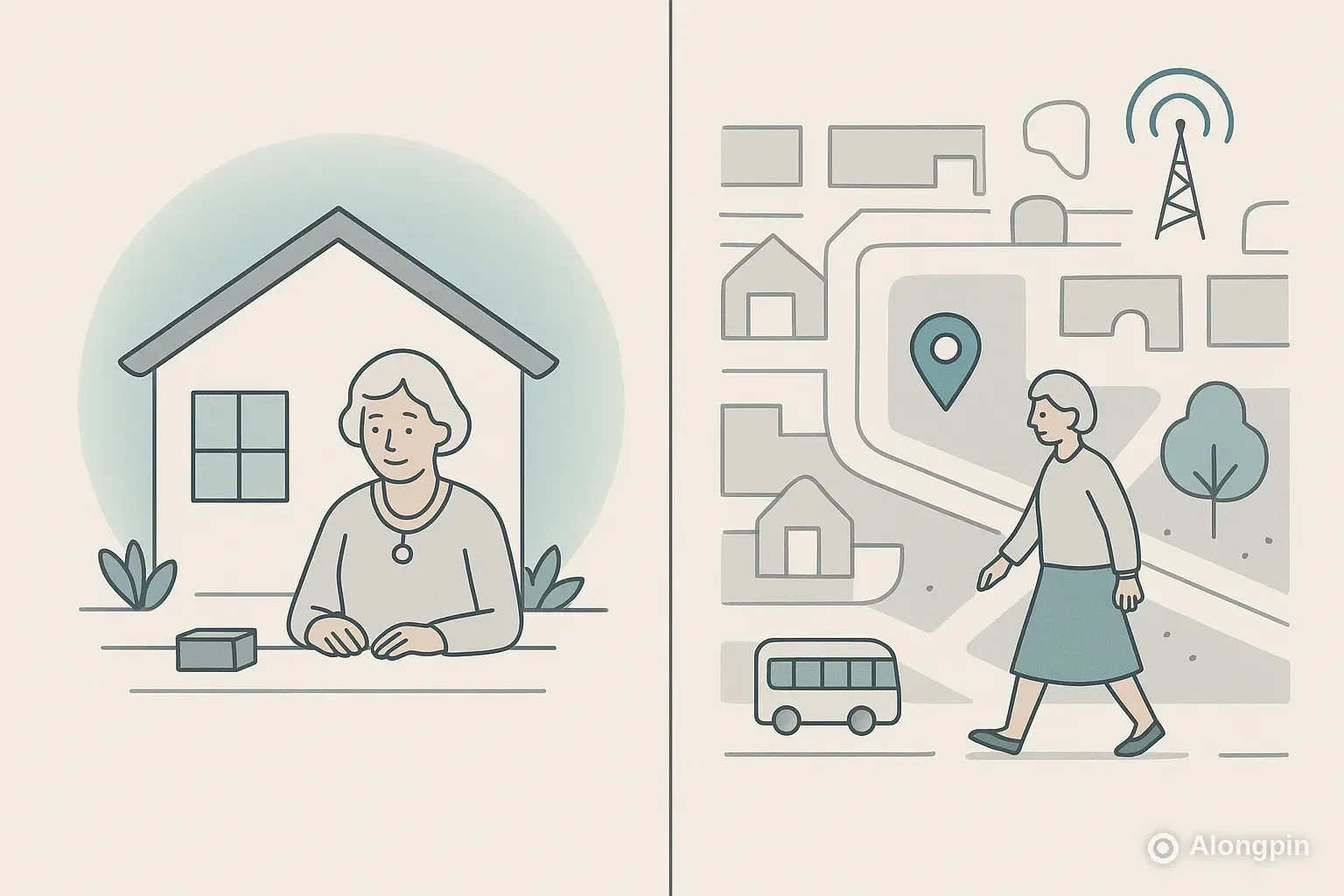
A home alarm unit and a mobile GPS alarm differ mainly in where they work. A traditional home alarm is a base station in the house with a pendant button that works within range of it, so it helps when your parent falls in the hallway but not at the market. A mobile GPS alarm, usually a watch or a small pendant with its own SIM, reports over the mobile network wherever there is coverage, and sends its position with the alert. For a parent who still shops, walks and visits friends, the mobile alarm covers the hours outside the front door; the home unit covers the house reliably without charging. Many families end up using both.
Key takeaways
- Home alarm: works in and around the house, plugged in, little to remember. Nothing outside.
- Mobile GPS alarm: works wherever there is mobile coverage and tells you where she is when she presses the button. It needs charging.
- Only a mobile device can tell you she left home, or show where she is when she does not answer.
- Fall alerts depend on the device on both sides: check the model.
- Using both together is common: the base unit at home, the watch when she goes out.
Quick comparison
| Home alarm unit | Mobile GPS alarm (watch or pendant) | |
|---|---|---|
| Where it works | Inside the home and close around it, within range of the base | Wherever there is mobile coverage |
| What you learn on a button press | That she pressed it, at home | That she pressed it, and where (on the map) |
| Power | Base plugged in; pendant battery lasts long | Must be charged regularly |
| Leaving home | Not known | An alert when she leaves her home zone |
| Location when she does not answer | Not available | Last reported position |
| Indoors | Designed for it | Position may be approximate indoors |
| Who answers | Depends on the service: a call centre or family numbers | The people you choose: family, neighbours, carers |
Where each works
A home alarm unit sits in the house, plugged into power and connected to a phone line or a mobile connection of its own. The button she wears on a cord or wristband talks to that base. Within the range of the base, which normally covers the home and perhaps the garden, it is dependable: no screen, no charging, nothing to set up. Outside that range it does nothing.
A mobile GPS alarm carries its own SIM and talks to the platform over the mobile network. It works in the house, on the bus, in the park and at her sister's flat, as long as there is coverage. Where there is none, the alarm cannot get through until the device reconnects.
What the family learns when the button is pressed
With a home unit, an alert means "she pressed the button at home". That is often enough: you know where to go.
With a mobile alarm on Alongpin, an SOS raises a care alert on her profile with the place it came from, shown on the map, and goes to the people you chose: the profile's owner, the family members it is shared with and the contacts marked to receive alerts, by the portal or the app, email and text message. Whoever takes charge acknowledges it, so the others see it is in hand. See the SOS page for what happens step by step.
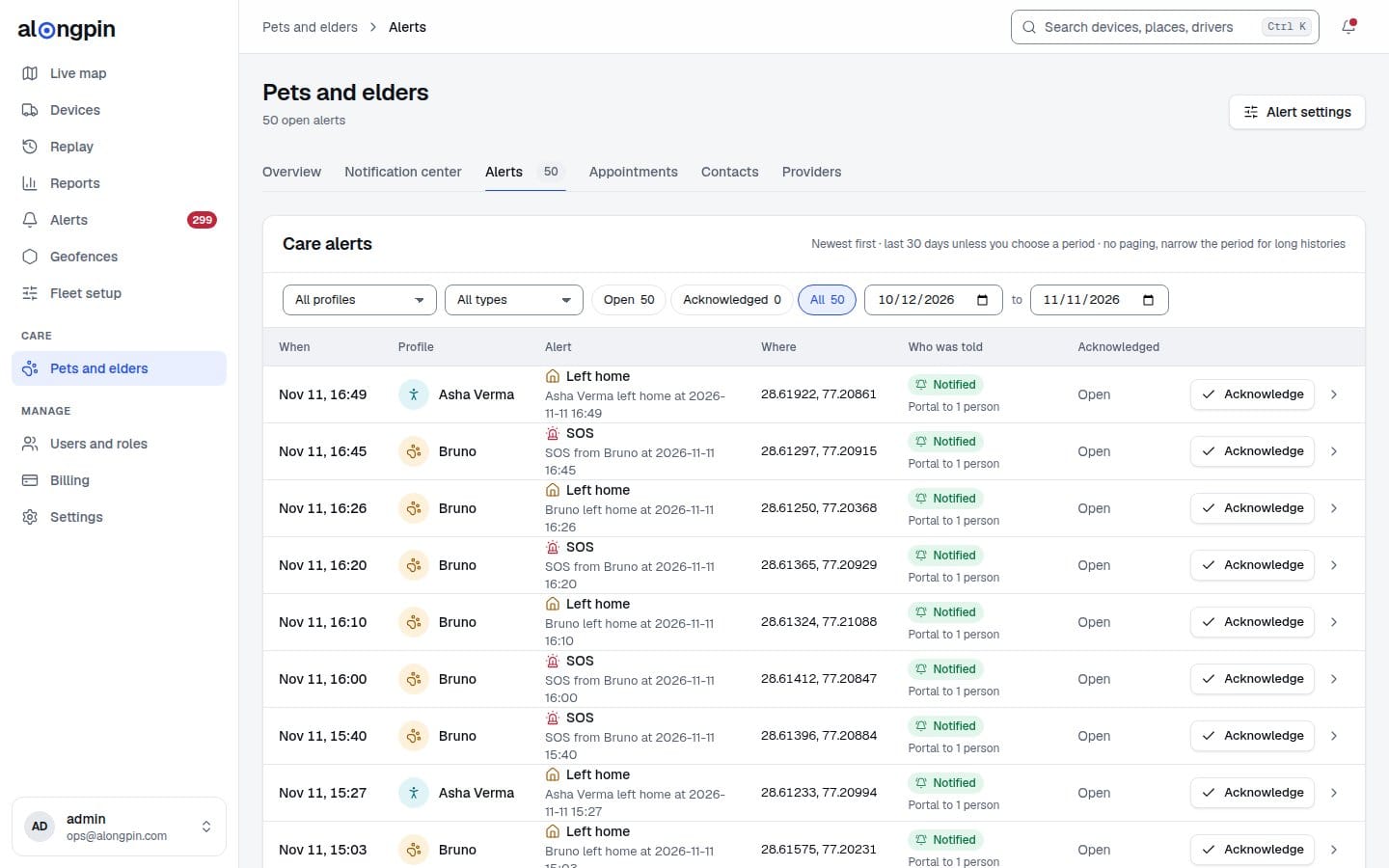
Two details matter here. Alert emails and text messages are short by default ("New alert for…, open the app"), and the full alert with the map is in the portal and the app. And where your installation requires consents, the position comes with the alert only under a location consent; SOS and fall alerts still arrive without one, but without a place.
Battery and charging against a plugged-in unit
This is the home unit's strongest point. Its base is on mains power and its pendant battery lasts a long time, so there is almost nothing for your parent to remember.
A mobile alarm uses power for GPS and mobile data, so it needs regular charging, often daily or every few days depending on the model and how often it reports. A watch left flat on the bedside table protects nobody. Three things help:
- a fixed charging moment, such as while she has breakfast;
- a Low battery alert switched on in her profile, so a relative is told before it dies;
- an alert when the device stops reporting, which a family member can set up as an alert rule for the device.
If your parent will not manage charging, a home unit, or both devices, may be the safer choice.
Features only a mobile device offers
Because it knows where it is, a mobile alarm can do things a home unit cannot:
- Left home. Draw her home as a zone and switch on the leaving-home alert. A relative is told when the watch leaves it, useful for someone who may wander, less so for someone who goes out every morning by choice.
- Where she is now. If she does not answer the phone, the live map shows the watch's last position.
- No movement. An alert when the watch has reported no movement for longer than you set, within the hours you choose, while it keeps reporting.
- Daily activity. On watches that count steps, the profile shows steps, active time and time at home per day.
What depends on the device: fall alerts come only from watches and alarms that detect falls and report them; many do not, and the platform does not detect falls from movement itself. The same goes for heart rate or blood pressure. Two-way calls through the watch are a feature of the watch, not of the platform. Check the model on the watches page before you buy.
Indoors and in coverage gaps
Indoors, many watches cannot get a GPS fix and report a less exact position, estimated from mobile masts or Wi-Fi, or the last known one. That is fine for "she is at home" and less good for "which room". In a cellar, a lift or a rural valley without coverage, a mobile alarm cannot send at all until it reconnects. A home unit designed for the house does not have this weakness inside the house, which is one reason families keep both.
Using both together
The two devices complement each other rather than compete:
- At home, the base unit is always on and never needs charging; it is the safety net for the night and the bathroom.
- Out of the house, the watch goes with her: SOS with a position, leaving-home alerts, a map when she does not answer.
- On the charger overnight, the watch is not needed, because the home unit covers the night.
Agree who answers each one. A home alarm service may call a call centre or a list of numbers; the mobile alarm on Alongpin tells the people on her care profile. Make sure the same neighbour is not expecting a call from one and a text from the other without knowing which means what.
Who should choose what
- She rarely leaves the house, and charging is hard: a home unit first.
- She is out every day, walks, shops, takes the bus: a mobile GPS alarm, with a charging routine.
- She may wander or get lost: a mobile alarm with a home zone and the leaving-home alert, and a conversation about what it means for her.
- She lives alone and is out some days: both.
The elder care solution describes how families set up a watch, contacts and alerts around a parent.
How Alongpin helps
Alongpin (alongpin.com) is a GPS tracking platform you open in a browser or on your phone. A parent's GPS watch or alarm becomes a care profile: SOS, fall, leaving-home and inactivity alerts reach the family and emergency contacts, and health readings, medication refills and appointments sit in one place you can share. See how it works for elder care, and check a watch in the device check.
Frequently asked questions
Does a mobile GPS alarm need a smartphone?
No. The watch or pendant reports by itself over its own SIM. The family sees it in a browser or on their phones.
Does a mobile alarm work abroad?
Only where its SIM has coverage and roaming is allowed. Check with the SIM provider before a trip.
Can a mobile alarm replace a home unit completely?
For an active parent who charges it reliably, often yes. If she takes it off at night or forgets to charge it, keep a home unit for the house.